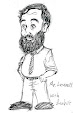
I was way out in the middle of Texas somewhere in my old International Travelall, one of those wagon-type trucks that was impossible to get parts for, so when the choke broke, I had rigged up an old wire through the dashboard to pull on when it needed more gas. It wasn't that safe because sometimes you needed an extra hand, but way out there there were only two speeds, very fast and old farmer, and I was kind of like the second one, so it didn't matter.
I was looking at the vast expanses of cattle country, miles of open range, the early morning sun in my eyes to the east, the dew melting off the wildflowers, when I saw this dirty old hitchhiker with a small pack that looked like the dust it was sitting in. I stopped and he threw the pack in the back. He had dirty hair and an old beard, his jeans were torn at the knee and a dirty old leather coat was also kind of worn out. But he was friendly enough, didn't smoke, thanked me for the ride, and wiggled around in the seat enough to get comfortable as we started again.
He eyed the homemade choke warily but I assured him that it was ok, it was handmade, but what can you do, you have to write away for International parts and even then you couldn't get them, and that took years. He said he was going to Dallas, and we established where I would drop him off, a hundred miles up the road or so. The sun was coming up over the horizon and shining an orangish glow in his beard as he turned a little to keep it out of his eyes. A strange beeping came from his coat and it kind of alarmed me, but it turned out to be a cell phone which he promptly answered. He turned away and kind of mumbled into it even though the reception was probably terrible; we were way out in the middle of nowhere. I had no idea what he was doing, but was grateful that it wasn't a gun, because theat could get ugly. It was probably just young kid business but who knows. I know so little about what young folks do on these things that I just concentrated on my driving and left him alone. And sure enough the call was over quick enough and he put it away.
But then a big old cockroach fell out of his pants and onto the floorboard of the truck. He stomped it out with his cowboy boot and it sat there squished up until he kind of pushed it over into the well at the side. It was one big ugly old dead cockroach by the time he was done with it. My jaw must have dropped about a mile, not because I'd never seen anything so hideous, but more because, way out in the country you don't see cockroaches so often. They're kind of city things. You see crickets, mice, armadillos, all kinds of stuff, but not cockroaches.
"Big ugly b---ard," he said, smiling. He was a little embarrassed, to his credit.
"Don't worry about it," I said. "It's not like I'm trying to keep the truck clean."
"You ever heard the cockroach theory of evolution?" he asked.
Well, it was still a long way to Dallas, and I figured, I got nothing else to do, so I figured he might as well tell it.
"In the beginning of time," he says, "there were these two cockroaches. They were friends. But one day they got into an argument. 'I could evolve into something better than you,' says one. 'Yeah, but we cockroaches are already pretty good. You don't need to evolve,' says the other. 'I think I'll evolve just to be better than you,' says the first. 'You go right ahead and do it,' says the second, 'I'll just stay the way I am.' So they went back and forth like that, and pretty soon it was a dare, and the first one set out to evolving. So he turns into a fish, and then a frog, and on up the ladder, and it took a number of generations, of course, but the second one just stayed a cockroach, he didn't evolve at all. And every time that frog or armadillo or whatever looked back at that cockroach, he saw that look of hatred, that look of recognition, in his eyes. Because I'll tell you something, one thing you can say about the cockroach, he's always watching, he's always ready to run and hide. He's always watching what we'll do next. Because you can guess what happened, all the way up that ladder...monkey, ape, human, whatever, that cockroach was still watching. And now, we're humans, and they're roaches, and you know what? There's no animal we hate more than cockroaches. NOne. There isn't a single person around that wouldn't tell you they're the most evil, most wicked, filthiest, sneakiest animal alive. And do you think they're any worse than any other bug? Not really. They're a little more aware of humans, maybe. They're a little more tuned into what we're up to. And that's why we hate them."
"So you can guess how this story ends," he says. "We evolve until we blow ourselves up. It's inevitable. Humans are smart, they make the bomb, they survive for a while, they hold off from destroying each other, but eventually, somebody blows everyone up, and then, you know what? The cockroach survives. Know why? Because all he is, really, is a shell, and a pair of eyes. He never got past that perfect and simple state where he was simple enough to survive the bomb. And why not? Because he chose not to. He knew what evolution entailed, and he didn't want it."
He laughed a little, and settled back into his seat again. Out the window, the wildflowers were picking up, shining in the morning sun, and there were signs of civilization again, houses, motels, gas stations, and the like, as we were coming into the outskirts of Fort Worth maybe. I'd never heard such a theory, but I"d never really thought about it, and I had to admit that most people including myself hated cockroaches way beyond what they were worth, when you turn on some light, and they all go scattering under some dirty stove. And it made me think some more, you know, sometimes it feels like the world is full of your friends, people like you, who think and feel all the same stuff you do, but other times, it just seems to be full of evil creatures like the cockroach, evil personified, the opposite of us, who are watching, waiting for their opportunity, just completely opportunistic.
Now this kid, he was nice enough, a little different from me, but a nice kid, and I had to say, he seemed to put his finger right on that aspect of life. And I had to thankhim for that wisdom, for after all, that's what you hope to get out of a hitchhiker, a little relief from the boredom and the monotony. When we got to the exit, I let him out, wiht his dirty old pack and his gentle smile, easy manner. He was a survivor. What he'd do in Dallas, I don't have a clue, maybe that's what the cell phone call was about. He collected his stuff and walked down toward the other highway. I pulled out that old wire choke, and headed off my own way, down the ramp, feeling better. Helping someone out gives you a good feeling, regardless of the circumstance, a warm feeling, entirely different from a hot Texas morning in an old truck.
(written 3-21-05, originally appeared in Unloading.
Tuesday, July 30, 2013

Thursday, July 18, 2013
Kerrville
Jacob woke up from a long nap and sat at a picnic table in a little clearing at the Kerrville Folk Festival in May of 2013. The Texas sun had been beating down where an old tree had fallen; they'd cleared the tree, but now it was sunny and bright most of the time, and they'd moved the picnic tables over toward the shade a little, away from a little stage that was set up at a little table where they sold CD's. People played varieties of folk music on that little shaded stage: first an accordion and a fiddler, then a couple of guitar players hacking away and competing with each other a little with their singing voices. The folks at Kerrville served food at that clearing at all hours, for a price, of course, so the place was always social and interesting, a pleasant break from Jacob's IT job in Wyoming, and his long boring drive down to the hill country of south Texas. The kinds of characters who passed through were interesting, too, but what was most interesting was the way it was the center of a wide, yet tight community, bound together against the outside world; people knew each other from previous years, and maintained a vocabulary or set of words that they used only at the festival.
A couple of young people came through; the man had matted hair down to the middle of his back, and the woman was quite pretty, with frizzy hair unwashed and wild at the edges. They introduced themselves as Matt and Debra. They had hitchhiked in from North Carolina a few days earlier and were going to hitchhike on up to Montana for a gathering later in the summer; they thought maybe they'd find a ride here if they looked hard enough. They smoked a joint with their coffee and offered it to Jacob, but he refused. Jacob said he'd be going to Wyoming in maybe four days; that would be most of the way, probably, and they were welcome to join him. They wavered. They appreciated the offer. Debra was a little more wary than Matt; Matt figured that a ride three quarters of the way was a pretty good deal.
Matt and Debra worked shifts at the festival, which ensured that they didn't have to pay the entrance fee; the main stage at the festival would be starting soon, so within a few minutes they were off to work their shifts. Time appeared to be a little different at Kerrville; now it was dinner time, but people were just waking up, going to work. The show would be seven to ten maybe, or eleven. Then the fun would start, apparently, from eleven on into the morning. But then of course, the sun would come out, and people would want to get some sleep, and get away from the heat.
Jacob, tired from a long drive, spent much of the evening at that picnic bench. Matt and Debra joined him again, later that evening, when the main stage show was over and things were getting a little livelier. Again, they were smoking pot with friends. Now their story was a little different; they couldn't work at Kerrville any more. Jacob asked why. It wasn't that they were high on their shift, they said, but what happened was that they'd been caught smoking publicly, which the workers weren't supposed to do. Easy come, easy go, Matt said; they'd gotten the job, they'd worked a few days, and now that gig was over.
Oh, to be young, Jacob thought, as he watched them; he was now 58, was just beginning to get his folk music onto the stage, and looked back at a lifetime of basically fitting into the system, making money, living in a single place. And he'd given up pot, maybe 36 years ago. He'd had some traveling days, though, at the age of nineteen, and had actually hitchhiked through San Antonio and this part of Texas, on the way into Mexico and all the way to Guatemala. Mexico and Guatemala had a different culture, different laws, different people; his Spanish was ok or barely functional, but he'd had a good time and met a lot of people. Near the Guatemalan border an American Army soldier had given him a ride; he was probably going to Nicaragua, this being forty years ago. The soldier explained that he was driving his own car, because he wanted to have it down there, while he was on base.
But he'd pulled out a bag of marijuana and insisted on smoking, and having Jacob roll one as he, the soldier, drove. Jacob had rolled one, but then when the aduana came up on the horizon, they had to hide the bag under the seat and throw the joint out the window. An aduana was a customs house; they were entering Guatemala. Jacob asked to be let out and enter the country separately, but it was too late. The customs house was quite formal; the officers checked the visas and the passports, while Jacob thought about the bag under the seat. It was no problem, however; the officer waved them through, and soon they were in Guatemala, again on some remote mountain road. The soldier again insisted that Jacob take out the bag and roll one, quickly, and he had, reluctantly. But now another aduana appeared on the horizon. As he found out later, they had entered the country first, but then had to enter its first state. This time, Jacob was a little rattled, and didn't hide it as well. As they stopped this time, the officer, a little overweight and with a gold tooth shining in the sun, laughed at them; he could tell, perhaps, that he'd find something, and in fact found a seed on the floorboard. He held the seed between his thumb and finger and said something in Spanish, his gold tooth shining in the sun. The sun beat down on them. The soldier got out of the car and walked the policeman over to the little house, telling Jacob to sit still.
Perhaps over there they'd come to some agreement, which involved transfer of money to the officer with the gold tooth. In fact it was transfer of Jacob's money, but could have involved transfer of the soldier's as well. This was almost the last of Jacob's money; he had only about sixty dollars, and the officer apparently demanded fifty. Jacob never found out for certain what the soldier himself had paid, if anything. But the issue was resolved, and soon they were on their way. Jacob had feared for his life. The soldier could have been guilty, or more likely could have simply believed that being a soldier would get him through, as he argued accordingly, and seemed to have been surprised that this argument hadn't worked. The memory had stuck with Jacob all these years.
Back in Kerrville, now much later in the evening, Jacob listened calmly as some young boy explained how marijuana was now legal in Washington and Colorado; however, there were complications, because it wasn't legal elsewhere, and it was still illegal at the federal level, and most employment was governed at the federal level. People also were getting used to it, used to growing it, smoking it, leaving it in their car. It was like gay marriage: there were complications, for people who traveled regularly. While they discussed this, people shared virtually everything Jacob saw. A guy bought a dinner and split it three ways. People passed bottles and joints around, sometimes surreptitiously. One woman gave another woman a piece of jewelry, turquoise, bought at the festival. People gave Jacob food and drink, and offered him things to smoke occasionally. Usually he refused; he wasn't quite used to it.
At about three in the morning, he sipped another coffee; on the stage nearby, two different people played music together, music which filled the air and floated up the hillside. At the table with him now were two women, who called themselves Eve and Mariah. Eve and Mariah were from Ohio and Connecticut respectively; they'd met at Kerrville. They each had boyfriends who were supposed to meet them there. Eve's boyfriend was coming in from Washington State, where he'd had a job and worked for about a month out on an island somewhere. It was a long hitch down from there and she really had no idea when he'd arrive.
A man, Kyle, came to join them at the table with his own coffee. Kyle was a little older, a veteran of Kerrville festivals, apparently.
Mariah's boyfriend had a different story. He'd been in San Francisco, and was supposed to hitch to Texas from there, but instead had been diverted to L.A. because of some kind of family emergency. This, however, meant that he'd hitched straight across ten, the road through Tucson and El Paso. Just this side of El Paso there was a roadblock.
"Wasn't that roadblock intended to catch illegal immigrants?" Jacob asked.
"Yes, but they can call out their dogs if they want," Kyle said. "And they do. Sounds like he got caught in a familiar trap; I've heard of this before. In these small towns, it's partly a matter of money. If they can get someone for a few days, they get hundreds in court costs. Oh yeah, they'll let him go eventually. But it'll take days, maybe weeks, a thousand or two, and that's not to mention what it'll do to his record."
Mariah put her head in her hands and slumped into the picnic table. On one level she'd known this when she'd first heard the news; it was only now sinking in as reality. She herself would probably have to go out and get him.
The sun was beginning to rise in the distant hills; Texas hill country was most beautiful at this time, when the searing heat had eased up a little, and a cool breeze drifted up from the valley fog. It would be another hot day, though, you could tell.
Jacob, in his mind, saw the shining gold tooth.
A couple of young people came through; the man had matted hair down to the middle of his back, and the woman was quite pretty, with frizzy hair unwashed and wild at the edges. They introduced themselves as Matt and Debra. They had hitchhiked in from North Carolina a few days earlier and were going to hitchhike on up to Montana for a gathering later in the summer; they thought maybe they'd find a ride here if they looked hard enough. They smoked a joint with their coffee and offered it to Jacob, but he refused. Jacob said he'd be going to Wyoming in maybe four days; that would be most of the way, probably, and they were welcome to join him. They wavered. They appreciated the offer. Debra was a little more wary than Matt; Matt figured that a ride three quarters of the way was a pretty good deal.
Matt and Debra worked shifts at the festival, which ensured that they didn't have to pay the entrance fee; the main stage at the festival would be starting soon, so within a few minutes they were off to work their shifts. Time appeared to be a little different at Kerrville; now it was dinner time, but people were just waking up, going to work. The show would be seven to ten maybe, or eleven. Then the fun would start, apparently, from eleven on into the morning. But then of course, the sun would come out, and people would want to get some sleep, and get away from the heat.
Jacob, tired from a long drive, spent much of the evening at that picnic bench. Matt and Debra joined him again, later that evening, when the main stage show was over and things were getting a little livelier. Again, they were smoking pot with friends. Now their story was a little different; they couldn't work at Kerrville any more. Jacob asked why. It wasn't that they were high on their shift, they said, but what happened was that they'd been caught smoking publicly, which the workers weren't supposed to do. Easy come, easy go, Matt said; they'd gotten the job, they'd worked a few days, and now that gig was over.
Oh, to be young, Jacob thought, as he watched them; he was now 58, was just beginning to get his folk music onto the stage, and looked back at a lifetime of basically fitting into the system, making money, living in a single place. And he'd given up pot, maybe 36 years ago. He'd had some traveling days, though, at the age of nineteen, and had actually hitchhiked through San Antonio and this part of Texas, on the way into Mexico and all the way to Guatemala. Mexico and Guatemala had a different culture, different laws, different people; his Spanish was ok or barely functional, but he'd had a good time and met a lot of people. Near the Guatemalan border an American Army soldier had given him a ride; he was probably going to Nicaragua, this being forty years ago. The soldier explained that he was driving his own car, because he wanted to have it down there, while he was on base.
But he'd pulled out a bag of marijuana and insisted on smoking, and having Jacob roll one as he, the soldier, drove. Jacob had rolled one, but then when the aduana came up on the horizon, they had to hide the bag under the seat and throw the joint out the window. An aduana was a customs house; they were entering Guatemala. Jacob asked to be let out and enter the country separately, but it was too late. The customs house was quite formal; the officers checked the visas and the passports, while Jacob thought about the bag under the seat. It was no problem, however; the officer waved them through, and soon they were in Guatemala, again on some remote mountain road. The soldier again insisted that Jacob take out the bag and roll one, quickly, and he had, reluctantly. But now another aduana appeared on the horizon. As he found out later, they had entered the country first, but then had to enter its first state. This time, Jacob was a little rattled, and didn't hide it as well. As they stopped this time, the officer, a little overweight and with a gold tooth shining in the sun, laughed at them; he could tell, perhaps, that he'd find something, and in fact found a seed on the floorboard. He held the seed between his thumb and finger and said something in Spanish, his gold tooth shining in the sun. The sun beat down on them. The soldier got out of the car and walked the policeman over to the little house, telling Jacob to sit still.
Perhaps over there they'd come to some agreement, which involved transfer of money to the officer with the gold tooth. In fact it was transfer of Jacob's money, but could have involved transfer of the soldier's as well. This was almost the last of Jacob's money; he had only about sixty dollars, and the officer apparently demanded fifty. Jacob never found out for certain what the soldier himself had paid, if anything. But the issue was resolved, and soon they were on their way. Jacob had feared for his life. The soldier could have been guilty, or more likely could have simply believed that being a soldier would get him through, as he argued accordingly, and seemed to have been surprised that this argument hadn't worked. The memory had stuck with Jacob all these years.
Back in Kerrville, now much later in the evening, Jacob listened calmly as some young boy explained how marijuana was now legal in Washington and Colorado; however, there were complications, because it wasn't legal elsewhere, and it was still illegal at the federal level, and most employment was governed at the federal level. People also were getting used to it, used to growing it, smoking it, leaving it in their car. It was like gay marriage: there were complications, for people who traveled regularly. While they discussed this, people shared virtually everything Jacob saw. A guy bought a dinner and split it three ways. People passed bottles and joints around, sometimes surreptitiously. One woman gave another woman a piece of jewelry, turquoise, bought at the festival. People gave Jacob food and drink, and offered him things to smoke occasionally. Usually he refused; he wasn't quite used to it.
At about three in the morning, he sipped another coffee; on the stage nearby, two different people played music together, music which filled the air and floated up the hillside. At the table with him now were two women, who called themselves Eve and Mariah. Eve and Mariah were from Ohio and Connecticut respectively; they'd met at Kerrville. They each had boyfriends who were supposed to meet them there. Eve's boyfriend was coming in from Washington State, where he'd had a job and worked for about a month out on an island somewhere. It was a long hitch down from there and she really had no idea when he'd arrive.
A man, Kyle, came to join them at the table with his own coffee. Kyle was a little older, a veteran of Kerrville festivals, apparently.
Mariah's boyfriend had a different story. He'd been in San Francisco, and was supposed to hitch to Texas from there, but instead had been diverted to L.A. because of some kind of family emergency. This, however, meant that he'd hitched straight across ten, the road through Tucson and El Paso. Just this side of El Paso there was a roadblock.
"Wasn't that roadblock intended to catch illegal immigrants?" Jacob asked.
"Yes, but they can call out their dogs if they want," Kyle said. "And they do. Sounds like he got caught in a familiar trap; I've heard of this before. In these small towns, it's partly a matter of money. If they can get someone for a few days, they get hundreds in court costs. Oh yeah, they'll let him go eventually. But it'll take days, maybe weeks, a thousand or two, and that's not to mention what it'll do to his record."
Mariah put her head in her hands and slumped into the picnic table. On one level she'd known this when she'd first heard the news; it was only now sinking in as reality. She herself would probably have to go out and get him.
The sun was beginning to rise in the distant hills; Texas hill country was most beautiful at this time, when the searing heat had eased up a little, and a cool breeze drifted up from the valley fog. It would be another hot day, though, you could tell.
Jacob, in his mind, saw the shining gold tooth.
Tuesday, July 16, 2013
be a Reader
This is how it works. I send you the documents as attachments to e-mail; you take some time to read them; you give me some advice, then, when it's all over and they are published, as a story or novel or whatever, you get one, for free. It may take me a while, but I will have one sent to you. If you want it signed, you'll have to find me, but anything is possible.
My fourth collection of stories is just going to press. Really, I needed readers for this one, but didn't quite manage to find people and get it to them in time. I became impatient and just published it. If you want a copy I can still send you the document; if you're a reader, I'd be glad to show you. But what I really need now is someone to go through all four sets of stories and help me compile a "Best of" volume. The first (Unloading) was never published at Amazon and the doc file is actually lost; the other three will be easy to send you. Let me know, though, and I'll figure out how to get all of them to you.
I have thin skin and don't take criticism well. I'm doing my best to reform though. If you are shy and don't want to tell me why something is bad, don't. Tell me what's good & I'll infer. If you can't do that, tell me anything. I need to hear it. I'm beginning to write my novel, and I have lots of poetry out there. Interested? write me. Don't be shy!
My fourth collection of stories is just going to press. Really, I needed readers for this one, but didn't quite manage to find people and get it to them in time. I became impatient and just published it. If you want a copy I can still send you the document; if you're a reader, I'd be glad to show you. But what I really need now is someone to go through all four sets of stories and help me compile a "Best of" volume. The first (Unloading) was never published at Amazon and the doc file is actually lost; the other three will be easy to send you. Let me know, though, and I'll figure out how to get all of them to you.
I have thin skin and don't take criticism well. I'm doing my best to reform though. If you are shy and don't want to tell me why something is bad, don't. Tell me what's good & I'll infer. If you can't do that, tell me anything. I need to hear it. I'm beginning to write my novel, and I have lots of poetry out there. Interested? write me. Don't be shy!
Thursday, July 4, 2013
e pluribus haiku 2013
Available on Amazon
Paperback $3.59
Kindle $1.99

Over 750 haiku, most from a journey in the seventies, from all 50 states and the District of Columbia. Whereas most contemporary haiku masters scorn the 5-7-5 syllable American haiku, this volume embraces it as a way of having a unifying structure for many different experiences, and celebrations of place, that these haiku illuminate.
Paperback $3.59
Kindle $1.99
Over 750 haiku, most from a journey in the seventies, from all 50 states and the District of Columbia. Whereas most contemporary haiku masters scorn the 5-7-5 syllable American haiku, this volume embraces it as a way of having a unifying structure for many different experiences, and celebrations of place, that these haiku illuminate.
Subscribe to:
Posts (Atom)