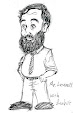
Looking for D.B.
Bob grew up in Washington State, and like many people, was fascinated by the skyjacking of the man they came to call D. B. Cooper, which happened when he was in high school. D. B. Cooper had boarded a plane from Portland to Seattle before Thanksgiving of 1971, told a flight attendant he had a bomb, got $200,000 ransom, took the plane and four crew members back south toward Portland, and literally jumped off the plane into a dark and stormy night, presumably with the money, and with a parachute of questionable quality. He was wearing only a trenchcoat and loafers, and the night was cold; after many years of looking, the FBI assumed he was dead. But he was never found, and that made the image of D. B. Cooper grow in the eyes of the public.
Two pieces of physical evidence were found on the ground; a placard giving instructions how to lower the back stairs of a 727 was found east of a town called Castle Rock, in 1978; and a package of $5800 was found buried in a place called Tena’s Bar, on the banks of the Columbia River, near Vancouver, in 1980. Mountains of evidence were collected and analyzed by the FBI, and dozens of people became suspects, but they had no solid evidence that he’d lived or died; they could find nobody like him who had disappeared on that Thanksgiving weekend.
Most people were obsessed with the general question of who D. B. Cooper really was; he clearly wasn’t D. B. Cooper, or Dan Cooper, as he’d told the airline when he bought the ticket. Bob, however, was more obsessed with what landed from the plane. He lived in Vancouver, Washington, and it wasn’t hard for him to go out looking in the rugged terrain of that part of the state; ge went for a few hikes up in the mountains and soon became eager for more. He had a friend, Gwen, who was also interested in the case of D. B.; they knew each other from high school. Though their personal and professional lives took them in different directions, as friends, they would see each other occasionally, and talk about D. B. Gwen frequently knew more of the FBI’s developments, since she was a forensic scientist and knew people in that field. Bob, however, got more into hiking and the terrain, as the years went by.
Like most people, and the FBI, Bob started his hunt near the town of Ariel, near Lake Merwin, and this didn’t change when the airline placard was found. But when the money was found, it seemed more like it had come down the Columbia River, and therefore it made more sense to check in the Washougal River valley, a little further east. Bob started out looking in public lands, wherever there were forests, and trails, and preferred the places that were less travelled. Soon, he became better at hiking; he got camping equipment; he gave himself more time.
Eventually, it occurred to him that he should use his education to figure out a little more about what had fallen from the plane. What possible flight path could a placard have? Three packets of twenty dollar bills? As the eighties went on, he studied vectors, and gravity, and wind conditions, and everything that could have influenced the falling of either the money packets or the placard. From their location, and from what he knew about the plane’s altitude, and speed, and wind conditions, he tried to determine what would be the best place to look.
There was no shortage of people, besides Gwen, who were willing to speculate and trade information about what had happened. The town of Ariel held D. B. Cooper Days, on a single day, once a year, and once Bob stumbled into it. But he came to dislike talking about it; he preferred hiking, alone, and thinking about various possibilities. When he talked to people, he found himself angry, either because they knew more than he did, or because they thought they knew more, or simply talked too much about it. He didn’t like talking about it, but he came to love the search itself. He maintained his friendship with Gwen, though, because they had actually been friends before the D. B. incident even happened. Somehow it was easy to talk to her, though she was a scientist, so different from him. And she kept up with his search; she knew what he was after.
The thing about the money was, there were really three batches. There was the $5800 that was found, in as bad condition it was in, buried at Tena’s Bar. But it had $200, all in twenties, pulled out of it, and none of that $200 was ever found. And the ransom that it was pulled out of, $194, 000, was never found either. Bob spent considerable time obsessing about what could have happened to either batch, or even, how the first batch could have ended up at Tena’s Bar, where a dredging of the river had probably buried it, by most accounts. He obsessed about the money because, unlike others, he didn’t care who D. B. Cooper actually was; also, he figured if he found the money, he would be likely to find the man himself, or the ruins of him, and he had to prepare himself mentally for that. He spent his weekends hiking in the most likely places. He did a consistent search of rugged mountain terrain that lasted much of his adult life, almost forty years.
He reasoned that the $5800 set of three packets which was found at Tena’s Bar had actually fallen into the Washougal River or the Columbia River watershed somewhere just on the other side of Vancouver, so during the eighties and nineties, he spent much of his time up the Washougal, on paths that led into the forested Cascades. He became very familiar with the Washougal River Road, and places like Prospector’s Creek, Meander Creek, the Silver Star Scenic Area, and the Gifford Pinchot National Forest. He started out on the marked trails, reasoning that anyone who was walking out of the forest would end up on these trails anyway, but he also took every chance he could to explore, off the marked paths, sometimes in a limited way, since he always had to worry about never getting lost. Altogether he spent many weekends in the woods, camping, taking pre-cooked meals and setting up a tent in little glades along the path. He enjoyed being alone. He thought of all the possibilities: where D. B. could have landed; under what scenarios he could have lived; what he could have done with the money if, after forty years, none outside of the Tena Bar packets had ever been found.
Meanwhile the rest of the public kept up its search as well, although people were mostly fascinated with who D. B. Cooper could have been. By 2009 there was an independent group working with new technology to analyze old evidence; the FBI had given up on the case, but they were more than willing to share what they knew. Speculation focused on a tie D. B. Cooper had allegedly left behind on the plane; traces of metal were found on the tie that suggested he worked for Boeing or perhaps another manufacturing plant. The group was called the Cooper Research Team, and Bob, now quite a bit older, knew a few of the members; Gwen knew even more of them, and was either on the team, or very close to it. He was still hiking, almost forty years after he had started, up in the Washougal Basin, regularly. He still disliked talking about it, but kept up on developments the best he could from what they published, what they said, and what appeared on the news. There was great excitement anytime anything new was found; in fact, when the case appeared on television on the news, in any bar or restaurant in the area, people would perk up and listen. Bob was like everyone else in that regard. Unlike everyone else, though, he was very familiar with the terrain where D. B. had probably jumped. He knew wide swaths of that forest.
Oddly, money with the serial numbers of the ransom money had never appeared anywhere except Tena’s Bar. If D. B. had given $200 to the five people who had flown him over the Cascades, none of it ever appeared. If he had landed and walked out of the forest, as far as anyone could tell, he hadn’t spent a single bill of the ransom. The serial numbers were well-known, and published; people had been watching for them for forty years now. Not a single genuine one had been found, outside of the packets at Tena’s Bar.
But one day Bob, coming back from a two-day hike up near Mt. St. Helens, stopped in the town of Washougal to eat a lunch he had packed, at a place called Sandy Swimming Hole. It was a summer day, late in the afternoon, but Bob didn’t feel like swimming, since he needed to get home that evening. After he ate he took a walk down by the river, which he often did, but this time he found a scrap of a bill, a twenty, in the weeds by the river. It was worn, and it was just a piece; it didn’t have a serial number, but he knew it was a twenty, because he could see a piece of the word “twenty” that was written on it. It was well worn by time; it was now what, forty years since D. B. had dropped his money from the sky. Bob was certain that this was one of D. B.’s bills.
It occurred to him that he should turn in this piece, as a third piece of evidence, and that this piece was important, as it could prove what Bob and others had suspected all along, that the answer was in the Washougal River Valley, as opposed to up near Ariel, or Castle Rock, or perhaps across the Columbia, as others had speculated. Yet, in a way, he knew it didn’t prove a thing for sure. And it was now covered with his own fingerprints, making any DNA work harder to do, and ensuring Bob would be dragged in somewhere for questioning.
He happened to see Gwen at a local diner and sat down with her for a while to talk about recent developments. She had been drawn into the Cooper Research Team, partly because of her knowledge of hard metals and forensic evidence that was commonly found on things like ties. She was eager to tell how this had led to their mapping every place that could have had titanium and other such metals, at that time, in the 1970’s, when D. B. would have gone to these plants. Their search had inevitably led them to the Boeing complex, where they were aware there had been a huge layoff just before Thanksgiving of 1971. Still, at this point, they weren’t able to pin it down.
Bob watched Gwen, in the diner, silently trying to decide whether to tell her about his find. She, too, would know how to get DNA evidence off the bill; she would also probably be aware of other clues they could find from the frayed nature of the bill. Something held him back, though. She was an old friend of his, and he trusted her. But he was alienated from the process she was going through: finding the traces of minerals, tracking down the identity. He didn’t care about the identity. And, what he had found was so small, he told himself, it was probably only significant to him. He didn’t want to give it up.
In the end, he kept the piece of the bill, and never told anyone about it. He kept it as a souvenir, well preserved, as a memento of the many years he’d spent in the woods. He was already getting older, more tired; it was harder for him to walk fifteen, twenty miles a day on weekends, and he was beginning to let go of it. But, having found one piece of one bill, he at least felt vindicated. He had a role that very few people had; he’d uncovered real physical evidence. But its secrets would die with him; he decided not to share what he knew. Like other evidence that had been uncovered, this piece created more questions anyway, questions for which there really were still no answers. And it raised another question in his mind: were there people like him, out there, who knew things, but simply wouldn’t tell? He was sure there had to be. But he now felt like a member of a privileged club, and he intended to guard his own secret, however insignificant. He never told a soul what he’d found.
(1-17)
Saturday, January 21, 2017

Wednesday, January 11, 2017
Sacred
Liz and Peter left North Dakota for Colorado, their home, late one afternoon; they’d agreed to drive home together after about three days at the demonstration against the pipeline at the Standing Rock reservation. They had gone there on a lark, mostly, but Peter, before they had even left, had given Liz an old ring that he’d found in his mother’s jewelry box. His mother agreed that he could give it to Liz, with the understanding that it was an engagement ring. The two had been talking about marriage for a while, but were both quite young, and uncertain about their future.
It was a long drive from North Dakota to Colorado, and it was mostly open, empty, and bitterly cold plains. Also it was likely to be dark for most of the trip, though they were young, and both claimed they didn’t mind driving all night if they were talking about something interesting. Getting a hotel was possible, but would stretch their budget, so they preferred just going on through the night, talking about whatever came up. Every once in a while they’d come to an exit, with golden arches, maybe, or a truck stop, but they decided they’d keep on driving and talking as long as they could.
For a while Peter was talking about the Spaghetti Monster. He’d been stuck thinking about the Spaghetti Monster ever since he’d learned that he was distantly related to the guy who had first invented it, in Kansas. The essence of the story, as told in the family, and as Peter related it to Liz, was that the state’s justification for teaching creationism in school was that you couldn’t prove that God didn’t create the earth. So, this guy who challenged the law, said Peter, said you also couldn’t prove that the Spaghetti Monster didn’t create the earth. And he invented the Spaghetti Monster, with its various tentacles, and two meatballs in it, and went on, in defiance, insisting that he believed that the Spaghetti Monster created the universe.
Peter went on about how the movement caught on, and people had started wearing colanders on their heads for pictures where religious headgear was allowed, for example, on drivers’ licenses. This had been picked up in various places, and the movement was especially big in Europe, where various courts had ruled that even movements that seemed to be a parody of true religion were just as valid as true religions, if people maintained that they believed in them. If we thought a colander was sacred, said Peter, who was anyone to judge what was parody and what was real?
Liz, at this point, was driving. The road was straight and long, and the night seemed endless, and it was so cold that she couldn’t crack the window. She didn’t want to argue with Peter, whom she dearly loved, but she thought that the Spaghetti Monster was ridiculous. People who made a big deal about a fictional character with many tentacles and two meatballs were ridiculing religion, and God, and of course they should be allowed to do it, but that didn’t make it right. She didn’t say anything, though. She was, as she drove, receiving texts from her mother, who kept asking about her progress on the road, and telling Liz about her own adventure, down in the San Juan Mountains of Colorado, where she was cleaning out her aunt’s old house, along with her sister. The aunt had died about a month ago, and there had been a funeral service, which Liz had attended, though she hadn’t known the aunt, her great aunt, well; it was a fairly close family, though they didn’t see each other a lot. Peter would read the texts out loud to her as they came in, since she was driving. Liz would then tell Peter what to respond. This went on for a while, as it became later; it was nine, nine-thirty, ten, and the road went on endlessly, once they’d filled up with gas. Peter, along with answering the texts, was also in charge of music, which he chose very deliberately. Liz concentrated on staying within the speed limit, though, with her ring hand on the steering wheel, she’d often rub the ring with her other hand. It was so easy, out here in the middle of nowhere, to just go eighty, but she was determined to not get a ticket, and to make it home.
Peter, it seemed, was even more stuck on the Spaghetti Monster, since he’d met some Europeans at Standing Rock who were able to give him a report of some of the things they did in Europe. Now, however, after a point, Liz was getting a little irritated. The Flying Spaghetti Monster people, he said, maintained that basically nothing was sacred, unless people agreed that it was. Therefore, if they agreed that a Spaghetti Monster was sacred, it was. And on and on he went. Finally she decided to respond.
“But what about the Standing Rock?” she asked. “To them, water was sacred. Old grave sites were sacred. That was the point of the demonstration. That’s why we went to North Dakota in the first place,” she said. There was a conch, that a Native American had given her at Standing Rock, in the seat beside them, and she picked it up and put it in his hand. “What do you think they would say about the Flying Spaghetti Monster? Did you ask them?”
He was quiet for a while, but finally he admitted that he was talking about it, not so much because he believed in it, but to work out how he felt about it in his mind. “Some things,” he said, “might have been sacred at one time, but lost their meaning over time, like that ring,” he said, and pointed to her ring, which was right on top of the steering wheel as she drove. It was a beautiful old ring, obviously very good quality silver, with an inlaid design, but, he said, he had to admit that the best he knew from his family, well, he didn’t really know very much about it. It had been in the family for a while. It had belonged to one of his grandparents, but probably had gone back way before then, when rings were made differently, and also when they meant more. Or rather, it seemed that way, he said, since you don’t really know what things mean to people, unless you ask, and even then you often don’t know. This last part he mumbled, as a kind of admission that he and his family weren’t able to conjure up much of the history.
Liz, inexplicably, began to cry, as she drove. It upset Peter, a lot, and they switched drivers, but this was partly because she was tired, and it was his turn, and they’d have to switch eventually anyway. She was also receiving the last of the texts from her mom, who was going to bed back in Colorado, though it was actually earlier out there than in the midwest. As Liz settled in the passenger seat, and Peter started driving, she gathered up her phone and read the old texts. Mom was now texting about some candles that they’d found in the aunt’s house. These candles were part of a story; the aunt, and her sister, had kept the candles for years, but had never lit them; when they actually wanted to light a candle, they’d go get another kind. When Liz and her mother had questioned the old sisters about what they were doing, many years back, when Liz was a young girl, they had said that the candles were sacred, and had come down through the family, and were to be used in a certain way, but they didn’t remember the way, so they didn’t use them. They had remembered the sacredness, and protected it, yet didn’t remember the exact meaning. The candles had actually been smuggled up there, they said, and they wanted to protect them at all costs.
The two aunts, both sisters of Liz’s mom’s father, had told them this together, several years ago, but one sister died shortly after, and the second sister had just died about a month ago. Thus the memory of what they said was still fairly clear, though neither Mom nor Liz could ever figure out what they’d meant by “smuggle” or even “up there” – which could have meant they were illegal down in the valley? In Colorado? This didn’t make sense. Candles, it seemed to Liz, weren’t illegal anywhere, really.
Maybe they were Marranos, Peter said. And then, he explained a little about Marranos. He happened to know, because he knew a lot about history, and this was a topic that had always fascinated him.
The Marranos were Jews in Spain and Portugal, around the time of Columbus, who were forced to either convert to Christianity or leave Spain. Many chose to leave Spain or Portugal. Many ended up in far-flung parts of the world, like the Amazon Valley or elsewhere. But some had actually gone with Spanish or Portuguese explorers, and decided to get as far away as they could from the center of the Empire, so as to be left alone. And thus, some came to Mexico City, and followed the early explorers north, as far as New Mexico or Colorado, which at that time were the far reaches, as far as you could get, from the centers of power. If you were Jewish, he said, your choices were to convert, to go as far away as you could, or do both. Or, a third option, go as far as you could, pretending to have converted, and then be free once you were at your destination. But the problem was, these remote people, or communities, in some cases, would try to keep their religion, once they got where they were going, but things would get lost. They’d lose track of the rituals, and would have no contact with other Jews, or with any formal organization that could do that for them. In those days, they didn’t have phones, or even newspapers, or anything else. And the San Juan mountains were very remote.
At this point Liz was in the passenger seat; her mom had stopped texting, having gone to bed. But Peter’s story rang a bell with her; she thought this was very possible. She had been brought up, really, without a religion. Her mom had freely admitted that she’d let go of her religion as a child; her dad never mentioned the subject. When Christian religious holidays, like Christmas and Easter, came around, they would celebrate them, but only in a token kind of way, not really religious. Unlike the Standing Rock, they didn’t really have anything that was truly sacred to them; they lived in a world where the parents, both being scientists, rarely even discussed these things. Yet she knew a little about the family history, and knew this was possible. She listened to Peter’s story and entertained the possibility.
Peter now had driven for a while, and Liz, finally, fell asleep, exhausted. Peter himself had grown up in a religious family, where lots of things were sacred, but he had always disdained the prescribed meaning of everything – cup, altar, crucifix, statue; it seem to him that people put too much importance in these, and that’s why he’d been attracted to the Spaghetti Monster. If people were going to be like that, he thought, he would use his power to make fun of them, or to show how ridiculous they were. He didn’t want to accept someone else’s definition of sacred, or the idea that some objects were so close to holy.
But he was also deeply in love with Liz, and could see that his even mentioning it, or bringing it up, had been hurtful to her. Having nothing as sacred was like being at sea, being lost, having no culture at all. It was ok for him, as he was questioning everything, and, being young, rejecting everything his parents were assuming he’d pick up. Part of being young, though, he thought, would be making their own way, he and Liz, starting a new life, finding their own path in the world. He determined not to bring it up again, not to make her cry.
At one point Peter himself became too tired to drive, and, at a rest area, pulled over, turned the car off, and slept a little, until the car became too cold and they both woke up. Liz, now, was ready to drive, and drove until they got home. Hungry and needing coffee, still they chose to just drive and talk, trying to process what they’d seen and heard at Standing Rock. She’d been heavily influenced by the Standing Rock and the demonstration, and came home interested in water issues, pipelines and environmentalism, unlike Peter, who was more interested in political end of it, and issues of the powerless, fighting against the big corporations. They were really quite different, Liz and Peter, but got along very well, and made a good couple, and they were deeply in love with each other.
They got married within a couple years, and though Liz had inherited the candles – that was why her mother had been texting her, really – it was years before they even thought about religion, or did anything about it. Peter, who loved history in all its forms, dug up some accounts of Spanish explorers leaving Mexico City, coming all the way north, through a great desert, and up into New Mexico and finally the San Juans, an enormous voyage, almost incomprehensible; it made their long trip across the plains, in the winter, seem like a walk to the park. Unfortunately, while they were camping, Liz lost the ring. But they kept the memories of things they’d done together, and they would frequently remind each other: things are as sacred as you make them. They themselves would decide how sacred anything was. Hopefully they would decide together, respecting each other’s differences and growing together. She kept the old conch, and put it in her kitchen window, and Peter never mentioned the Spaghetti Monster again.
It was a long drive from North Dakota to Colorado, and it was mostly open, empty, and bitterly cold plains. Also it was likely to be dark for most of the trip, though they were young, and both claimed they didn’t mind driving all night if they were talking about something interesting. Getting a hotel was possible, but would stretch their budget, so they preferred just going on through the night, talking about whatever came up. Every once in a while they’d come to an exit, with golden arches, maybe, or a truck stop, but they decided they’d keep on driving and talking as long as they could.
For a while Peter was talking about the Spaghetti Monster. He’d been stuck thinking about the Spaghetti Monster ever since he’d learned that he was distantly related to the guy who had first invented it, in Kansas. The essence of the story, as told in the family, and as Peter related it to Liz, was that the state’s justification for teaching creationism in school was that you couldn’t prove that God didn’t create the earth. So, this guy who challenged the law, said Peter, said you also couldn’t prove that the Spaghetti Monster didn’t create the earth. And he invented the Spaghetti Monster, with its various tentacles, and two meatballs in it, and went on, in defiance, insisting that he believed that the Spaghetti Monster created the universe.
Peter went on about how the movement caught on, and people had started wearing colanders on their heads for pictures where religious headgear was allowed, for example, on drivers’ licenses. This had been picked up in various places, and the movement was especially big in Europe, where various courts had ruled that even movements that seemed to be a parody of true religion were just as valid as true religions, if people maintained that they believed in them. If we thought a colander was sacred, said Peter, who was anyone to judge what was parody and what was real?
Liz, at this point, was driving. The road was straight and long, and the night seemed endless, and it was so cold that she couldn’t crack the window. She didn’t want to argue with Peter, whom she dearly loved, but she thought that the Spaghetti Monster was ridiculous. People who made a big deal about a fictional character with many tentacles and two meatballs were ridiculing religion, and God, and of course they should be allowed to do it, but that didn’t make it right. She didn’t say anything, though. She was, as she drove, receiving texts from her mother, who kept asking about her progress on the road, and telling Liz about her own adventure, down in the San Juan Mountains of Colorado, where she was cleaning out her aunt’s old house, along with her sister. The aunt had died about a month ago, and there had been a funeral service, which Liz had attended, though she hadn’t known the aunt, her great aunt, well; it was a fairly close family, though they didn’t see each other a lot. Peter would read the texts out loud to her as they came in, since she was driving. Liz would then tell Peter what to respond. This went on for a while, as it became later; it was nine, nine-thirty, ten, and the road went on endlessly, once they’d filled up with gas. Peter, along with answering the texts, was also in charge of music, which he chose very deliberately. Liz concentrated on staying within the speed limit, though, with her ring hand on the steering wheel, she’d often rub the ring with her other hand. It was so easy, out here in the middle of nowhere, to just go eighty, but she was determined to not get a ticket, and to make it home.
Peter, it seemed, was even more stuck on the Spaghetti Monster, since he’d met some Europeans at Standing Rock who were able to give him a report of some of the things they did in Europe. Now, however, after a point, Liz was getting a little irritated. The Flying Spaghetti Monster people, he said, maintained that basically nothing was sacred, unless people agreed that it was. Therefore, if they agreed that a Spaghetti Monster was sacred, it was. And on and on he went. Finally she decided to respond.
“But what about the Standing Rock?” she asked. “To them, water was sacred. Old grave sites were sacred. That was the point of the demonstration. That’s why we went to North Dakota in the first place,” she said. There was a conch, that a Native American had given her at Standing Rock, in the seat beside them, and she picked it up and put it in his hand. “What do you think they would say about the Flying Spaghetti Monster? Did you ask them?”
He was quiet for a while, but finally he admitted that he was talking about it, not so much because he believed in it, but to work out how he felt about it in his mind. “Some things,” he said, “might have been sacred at one time, but lost their meaning over time, like that ring,” he said, and pointed to her ring, which was right on top of the steering wheel as she drove. It was a beautiful old ring, obviously very good quality silver, with an inlaid design, but, he said, he had to admit that the best he knew from his family, well, he didn’t really know very much about it. It had been in the family for a while. It had belonged to one of his grandparents, but probably had gone back way before then, when rings were made differently, and also when they meant more. Or rather, it seemed that way, he said, since you don’t really know what things mean to people, unless you ask, and even then you often don’t know. This last part he mumbled, as a kind of admission that he and his family weren’t able to conjure up much of the history.
Liz, inexplicably, began to cry, as she drove. It upset Peter, a lot, and they switched drivers, but this was partly because she was tired, and it was his turn, and they’d have to switch eventually anyway. She was also receiving the last of the texts from her mom, who was going to bed back in Colorado, though it was actually earlier out there than in the midwest. As Liz settled in the passenger seat, and Peter started driving, she gathered up her phone and read the old texts. Mom was now texting about some candles that they’d found in the aunt’s house. These candles were part of a story; the aunt, and her sister, had kept the candles for years, but had never lit them; when they actually wanted to light a candle, they’d go get another kind. When Liz and her mother had questioned the old sisters about what they were doing, many years back, when Liz was a young girl, they had said that the candles were sacred, and had come down through the family, and were to be used in a certain way, but they didn’t remember the way, so they didn’t use them. They had remembered the sacredness, and protected it, yet didn’t remember the exact meaning. The candles had actually been smuggled up there, they said, and they wanted to protect them at all costs.
The two aunts, both sisters of Liz’s mom’s father, had told them this together, several years ago, but one sister died shortly after, and the second sister had just died about a month ago. Thus the memory of what they said was still fairly clear, though neither Mom nor Liz could ever figure out what they’d meant by “smuggle” or even “up there” – which could have meant they were illegal down in the valley? In Colorado? This didn’t make sense. Candles, it seemed to Liz, weren’t illegal anywhere, really.
Maybe they were Marranos, Peter said. And then, he explained a little about Marranos. He happened to know, because he knew a lot about history, and this was a topic that had always fascinated him.
The Marranos were Jews in Spain and Portugal, around the time of Columbus, who were forced to either convert to Christianity or leave Spain. Many chose to leave Spain or Portugal. Many ended up in far-flung parts of the world, like the Amazon Valley or elsewhere. But some had actually gone with Spanish or Portuguese explorers, and decided to get as far away as they could from the center of the Empire, so as to be left alone. And thus, some came to Mexico City, and followed the early explorers north, as far as New Mexico or Colorado, which at that time were the far reaches, as far as you could get, from the centers of power. If you were Jewish, he said, your choices were to convert, to go as far away as you could, or do both. Or, a third option, go as far as you could, pretending to have converted, and then be free once you were at your destination. But the problem was, these remote people, or communities, in some cases, would try to keep their religion, once they got where they were going, but things would get lost. They’d lose track of the rituals, and would have no contact with other Jews, or with any formal organization that could do that for them. In those days, they didn’t have phones, or even newspapers, or anything else. And the San Juan mountains were very remote.
At this point Liz was in the passenger seat; her mom had stopped texting, having gone to bed. But Peter’s story rang a bell with her; she thought this was very possible. She had been brought up, really, without a religion. Her mom had freely admitted that she’d let go of her religion as a child; her dad never mentioned the subject. When Christian religious holidays, like Christmas and Easter, came around, they would celebrate them, but only in a token kind of way, not really religious. Unlike the Standing Rock, they didn’t really have anything that was truly sacred to them; they lived in a world where the parents, both being scientists, rarely even discussed these things. Yet she knew a little about the family history, and knew this was possible. She listened to Peter’s story and entertained the possibility.
Peter now had driven for a while, and Liz, finally, fell asleep, exhausted. Peter himself had grown up in a religious family, where lots of things were sacred, but he had always disdained the prescribed meaning of everything – cup, altar, crucifix, statue; it seem to him that people put too much importance in these, and that’s why he’d been attracted to the Spaghetti Monster. If people were going to be like that, he thought, he would use his power to make fun of them, or to show how ridiculous they were. He didn’t want to accept someone else’s definition of sacred, or the idea that some objects were so close to holy.
But he was also deeply in love with Liz, and could see that his even mentioning it, or bringing it up, had been hurtful to her. Having nothing as sacred was like being at sea, being lost, having no culture at all. It was ok for him, as he was questioning everything, and, being young, rejecting everything his parents were assuming he’d pick up. Part of being young, though, he thought, would be making their own way, he and Liz, starting a new life, finding their own path in the world. He determined not to bring it up again, not to make her cry.
At one point Peter himself became too tired to drive, and, at a rest area, pulled over, turned the car off, and slept a little, until the car became too cold and they both woke up. Liz, now, was ready to drive, and drove until they got home. Hungry and needing coffee, still they chose to just drive and talk, trying to process what they’d seen and heard at Standing Rock. She’d been heavily influenced by the Standing Rock and the demonstration, and came home interested in water issues, pipelines and environmentalism, unlike Peter, who was more interested in political end of it, and issues of the powerless, fighting against the big corporations. They were really quite different, Liz and Peter, but got along very well, and made a good couple, and they were deeply in love with each other.
They got married within a couple years, and though Liz had inherited the candles – that was why her mother had been texting her, really – it was years before they even thought about religion, or did anything about it. Peter, who loved history in all its forms, dug up some accounts of Spanish explorers leaving Mexico City, coming all the way north, through a great desert, and up into New Mexico and finally the San Juans, an enormous voyage, almost incomprehensible; it made their long trip across the plains, in the winter, seem like a walk to the park. Unfortunately, while they were camping, Liz lost the ring. But they kept the memories of things they’d done together, and they would frequently remind each other: things are as sacred as you make them. They themselves would decide how sacred anything was. Hopefully they would decide together, respecting each other’s differences and growing together. She kept the old conch, and put it in her kitchen window, and Peter never mentioned the Spaghetti Monster again.
Subscribe to:
Posts (Atom)